
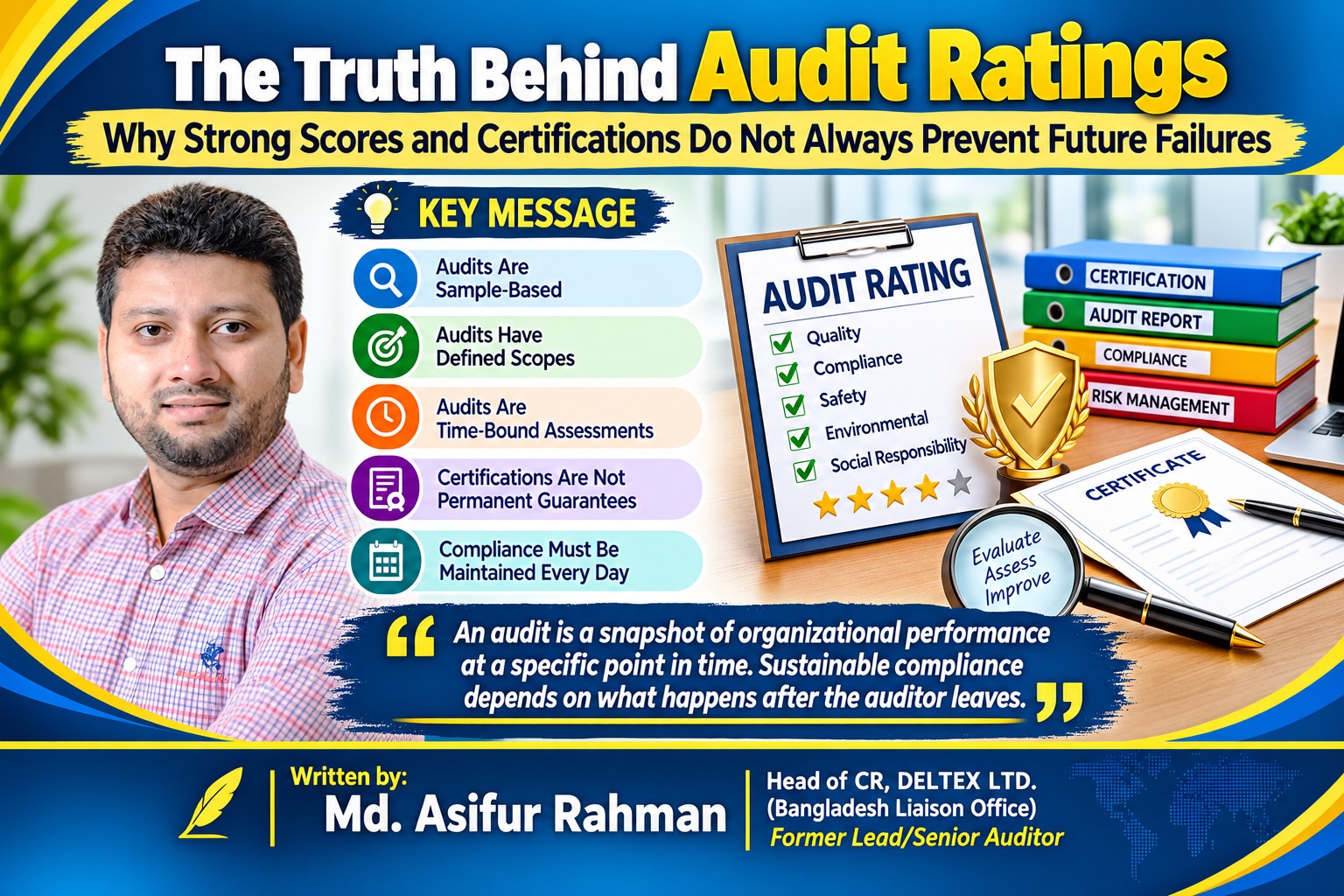
The Truth Behind Audit Ratings: Why Strong Scores and Certifications Do Not Always Prevent Future Failures
Introduction
When a Certified Factory Faces an Incident: Are Audits Really to Blame?
In today’s global supply chains, audits have become an indispensable mechanism for evaluating and monitoring compliance, organizational performance, and risk. Organizations regularly undergo assessments covering areas such as social compliance, occupational health and safety, technical requirements, management systems, security standards, environmental performance, and supply-chain integrity.
Depending on who conducts the assessment and who commissions it, these reviews are generally categorized as first-party, second-party, or third-party audits.
At the same time, organizations increasingly rely on certifications, assessments, and standards such as ISO standards, SA8000, BSCI, SMETA, WRAP, RSC, SLCP, C-TPAT, and other compliance frameworks. This has contributed to a common misconception: that once a factory receives a certification or achieves a favorable audit rating, it is somehow protected from future failures, accidents, or non-compliance issues until the certification expires.
However, when an incident occurs at a certified or highly rated facility, several questions naturally arise:
- How could this happen in a certified factory?
- What type of audit was conducted?
- Did the auditor fail to identify the issue?
- Was there negligence or unethical conduct?
- Did the organization deliberately conceal information?
These are reasonable questions. However, they can sometimes overlook a fundamental reality about the nature and purpose of auditing:
An audit is a professional assessment conducted within a defined scope, timeframe, and methodology. It is not a guarantee of perpetual compliance or the complete elimination of organizational risk.
Understanding this distinction is essential for businesses, auditors, customers, regulators, certification bodies, and other stakeholders who rely on audit results.
The Drinking Water Analogy
To better understand the limitations of audits, consider a simple example.
Suppose an organization decides to test the quality of its drinking water through a reputable laboratory. The laboratory collects a sample—or receives a sample provided by the organization—and conducts a detailed analysis. The results confirm that the tested water meets all applicable standards.
Naturally, everyone feels reassured.
But an important question remains:
Does that laboratory report guarantee the quality of the water for the entire year?
The answer is no.
The laboratory’s conclusion applies to the sample that was tested, under the specific conditions prevailing at the time of testing. Laboratory findings are generally associated with the sample submitted for analysis rather than serving as a permanent guarantee of future conditions.
Responsibility for maintaining the required quality standard after the test remains with the organization.
If contamination occurs at a later stage because the water source, storage system, distribution network, or related controls were not properly maintained, it would not automatically follow that the laboratory was responsible for the subsequent deterioration.
The same principle applies to audits.
An audit provides an informed assessment based on evidence reviewed during a defined period. It represents a snapshot of organizational performance, rather than a permanent guarantee of future compliance.
The “Rice Test” Principle
Many of us are familiar with a simple practice when cooking rice.
Rather than examining every grain individually, we test a few grains to determine whether the rice is cooked. Based on that sample, we form a conclusion about the condition of the entire pot.
Auditing works in a similar way.
Auditors review representative samples of documents, records, observations, transactions, processes, and interviews to form professional conclusions about an organization’s level of compliance.
It would be practically impossible for an auditor to examine every document, observe every activity, interview every worker, and verify every transaction occurring within an organization.
Therefore, sampling is a fundamental component of auditing.
The objective is not to examine everything. Rather, the objective is to obtain sufficient and appropriate evidence to form a reasonable professional conclusion within the defined audit scope.
What Actually Happens During an Audit?
Although audit methodologies vary according to the applicable standard, customer requirement, certification scheme, and audit objective, many audits follow a structured process.
- Opening Meeting
The audit team discusses the objectives, scope, methodology, requirements, schedule, and logistical arrangements with relevant representatives of the organization.
- Document Review
Auditors assess relevant policies, procedures, records, reports, registers, licenses, and other compliance documentation.
- Site Visit
The audit team conducts a physical inspection of facilities, workplaces, operational areas, equipment, safety arrangements, and relevant practices.
- Worker and Management Interviews
Interviews are conducted to assess employees’ understanding, implementation of requirements, workplace practices, and management systems.
- Internal Audit Team Discussion / Pre-Closing Meeting
The audit team evaluates and consolidates evidence and findings before communicating the results formally.
- Closing Meeting
The auditors present observations, findings, non-conformities, and areas requiring corrective action or improvement.
- On-Site Report Sharing
Depending on the audit program, preliminary findings or the audit report may be shared with the organization before the auditors leave the facility.
This process can be systematic, structured, and professional. Nevertheless, it remains subject to defined parameters and practical limitations.
Understanding the Limitations of Audits
To appreciate the true value of audits, organizations must understand not only what audits can accomplish, but also what they cannot reasonably be expected to accomplish.
- Audits Are Based on Sampling
Auditors do not review every document, observe every process, or interview every worker.
Instead, conclusions are drawn from representative samples selected according to the applicable audit methodology.
Consequently, audits generally provide reasonable assurance rather than absolute assurance.
A strong audit result therefore should not be interpreted as evidence that every aspect of an organization is continuously compliant.
- Audits Are Restricted by Scope
Every audit operates within specific terms of reference and an approved scope.
The scope may include:
- Applicable laws and regulations
- Customer Codes of Conduct (CoC)
- Certification requirements
- Defined physical locations
- Specific document-review periods
- Particular operational areas or processes
Auditors are generally expected to assess the areas included within the approved audit scope.
Therefore, an audit result should always be interpreted in the context of what was actually included in the audit.
- Access May Be Limited
The level of access to documents, records, systems, personnel, and locations may be defined before or during the audit.
Auditors can only review information to which they are granted legitimate access under the applicable audit protocol.
This means that the quality and completeness of available evidence can influence the auditor’s ability to identify and assess risks.
- Auditors Must Follow Professional Ethics
Professional auditors are expected to operate according to established ethical principles, including:
- Independence
- Objectivity
- Integrity
- Confidentiality
- Professional competence
These principles are fundamental to audit credibility.
At the same time, auditors must remain within their professional mandate. An auditor is not an organization’s day-to-day manager, operational controller, or permanent compliance monitor.
The responsibility for maintaining compliance therefore remains with the organization itself.
- Different Audits Have Different Objectives
Not every audit is designed to assess every aspect of an organization.
Examples include:
- Follow-up audits
- Focused audits
- Technical audits
- Security audits
- Environmental audits
- Corrective-action verification audits
In these circumstances, auditors review the areas relevant to the defined audit protocol.
However, where a serious or critical issue is observed and falls within the applicable reporting requirements, auditors have a professional responsibility to report or escalate the matter appropriately.
- Time Is Extremely Limited
Many audits take place annually or every two to three years, depending on the applicable program. Audits are frequently conducted within one or two days, although duration varies according to the required audit scope and man-day calculation.
Within such a limited timeframe, no auditor can realistically validate every organizational practice, behavior, transaction, decision, and management action occurring over months or years.
An audit therefore provides a snapshot rather than continuous surveillance.
This distinction is particularly important when interpreting audit ratings following a subsequent incident.
- Organizations Often Prepare in Advance
Many audits are announced or semi-announced in advance.
As a result, organizations may undertake extensive preparation before the audit, including reviewing documentation, organizing records, preparing employees, and ensuring that facilities are ready for assessment.
Preparation itself is not necessarily problematic. However, it can mean that auditors may not always observe exactly the same conditions that exist during ordinary day-to-day operations.
The difference between audit readiness and sustained operational compliance is therefore an important consideration.
- Standards Define What Auditors Review
Every standard, certification scheme, customer requirement, or audit protocol establishes the areas that auditors are expected to examine.
Whether an assessment concerns social compliance, management systems, security, environmental performance, sustainability, or another subject, auditors operate according to predefined requirements and guidelines.
Matters falling outside those requirements generally remain outside the audit scope.
Consequently, an audit rating should not automatically be interpreted as an assessment of every dimension of organizational performance.
Certification Is Not Compliance
Compliance Is a Daily Commitment
One of the most significant risks in interpreting audit results is the assumption that certification equals perfection.
In reality, certification or a favorable audit result indicates that an organization demonstrated conformance with specified requirements during the relevant assessment.
What happens after the audit depends largely on:
- Management commitment
- Operational discipline
- Internal controls
- Employee behavior
- Organizational culture
- Ongoing monitoring
- Corrective-action implementation
A highly rated facility today can become a higher-risk facility tomorrow if standards are not continuously maintained.
Conversely, an organization can improve its performance over time through strong leadership, responsible management, effective systems, and sustained commitment to improvement.
The sustainability of compliance is determined not simply by the auditor’s presence, but by what management and employees do after the audit has concluded.
Who Is Responsible When Things Go Wrong?
When an incident occurs at a certified or audited facility, it can be tempting to direct immediate criticism toward the auditor or auditing organization.
However, a more fundamental question is:
Did the organization continue to operate according to the applicable standards and requirements after the audit was completed?
If management fails to maintain controls, ignores established procedures, permits unsafe practices, or deviates from legal, customer, or internal requirements, accountability ultimately rests within the organization.
Audits can identify risks.
Auditors can provide findings and recommendations.
Certifications can provide evidence of conformity with specified requirements.
But none of these can replace:
Ethical leadership.
Effective management.
Operational discipline.
Strong internal controls.
And a sustainable culture of compliance.
What Should Organizations Learn From Audit Ratings?
Audit ratings should be treated as important management information—not as a permanent certificate of organizational perfection.
A strong score can provide useful evidence that an organization demonstrated conformity against defined requirements during the assessment period.
However, management should avoid allowing a favorable rating to create a false sense of security.
Instead, organizations should use audit results as an opportunity to:
- Identify and address underlying risks.
- Strengthen internal control systems.
- Monitor compliance continuously.
- Verify the effectiveness of corrective actions.
- Encourage employees to report concerns.
- Maintain standards between audit cycles.
- Build compliance into everyday operational decision-making.
The ultimate objective should not simply be to pass the next audit.
The objective should be to maintain the required standards even when no auditor is present.
Moving Beyond the “Audit-Day” Mindset
A sustainable compliance culture cannot be created by preparing only for an audit.
Organizations that focus primarily on achieving a favorable audit result may unintentionally create an “audit-day mindset”, in which compliance activities receive heightened attention immediately before an assessment and gradually lose attention afterward.
A mature compliance culture operates differently.
It treats compliance as an ongoing management responsibility rather than a periodic event.
The question should therefore move from:
“How do we achieve a good audit rating?”
to:
“How do we ensure that our systems, controls, and practices remain effective every day?”
This shift in mindset is essential for sustainable performance.
Final Thoughts
Audits are valuable professional tools—but they are not guarantees.
They provide an independent assessment of organizational conditions at a particular point in time, based on defined standards, available evidence, and sampling methodologies. They can help organizations identify risks, encourage improvement, and strengthen accountability across supply chains.
However, expecting any audit to verify every activity, identify every concealed or emerging issue, predict every future incident, or guarantee permanent compliance is unrealistic.
A strong audit rating should therefore be viewed in its proper context.
It demonstrates what was observed and evidenced within the defined scope and timeframe of the assessment. It does not necessarily demonstrate what will happen months later, under different circumstances, or when the organization is operating without the presence of an auditor.
True sustainability, safety, quality, and compliance are achieved not merely by passing an audit, but by maintaining the required standards every single day.
As professionals, business leaders, auditors, compliance practitioners, and factory managers, we should move beyond viewing an audit as the final destination.
Instead, we should recognize it for what it truly is:
A checkpoint on the journey toward continuous improvement.
And perhaps the most important measure of an organization’s compliance culture is not simply how it performs when the auditor arrives—but how it continues to perform after the auditor leaves.
Author:
Md. Asifur Rahman
Head of CR, DELTEX LTD. (Bangladesh Liaison Office)
Former Lead/Senior Auditor
ঢাকা বিভাগের আরো খবর


-

The Truth Behind Audit Ratings: Why Strong Scores and Certifications Do Not Always Prevent Future Failures
-

From Lead Auditor Training to Lead Auditor Recognition: Can We Claim to Be an Auditor or Lead Auditor After Successfully Completing an Auditor Course?
-

Four more RMG factories earn LEED certification
-
শ্রমিক নিরাপত্তা দিবস উপলক্ষে ট্রপিক্যাল নিটেক্স লিমিটেডে বর্ণাঢ্য আয়োজন
-

The Silent Cost of Turnover in Bangladesh’s Garment Industry: Why Retention Matters More Than Recruitment
-

পোশাক শিল্পে স্থিতিশীল কর্মসংস্থান ব্যবস্থা: টেকসই উন্নয়নের অপরিহার্য ভিত্তি
-

শুল্কের দেয়াল ভাঙার সুযোগ: মার্কিন বাজারে বাংলাদেশের বড় পরীক্ষা
-

Honoring Excellence: Texstream Fashion Ltd. Rewards Best Workers–2026
-

Control Union Bangladesh Hosts Country’s First-Ever Carbon-Neutral Sustainability Conference
-

বিডিআরএমজিপি এফএনএফ ফাউন্ডেশনের ৫ম প্রতিষ্ঠাদিবস উদযাপন
-

Human Resource Management in Bangladesh’s Garment Industry: From Administrative Duties to Strategic Transformation
-

স্বাস্থ্য সচেতনতা বাড়াতে মাধবপুরে মহানগর পাবলিক স্কুলে আরকে নিট ডাইং মিলসের স্বাস্থ্যবিধি ও প্রাথমিক চিকিৎসা প্রশিক্ষণ
-

Fakir Fashion and Epyllion Represent Bangladesh at UN SDG Forum 2025 in Bangkok, Thailand
-

Texstream Fashion Ltd. Successfully Completes 2-Month Quality System Training Program
-
Deltex Ltd. Bangladesh and Eurofins Assurance Co-Host Business Partner Seminar 2025







মতামত লিখুন :