
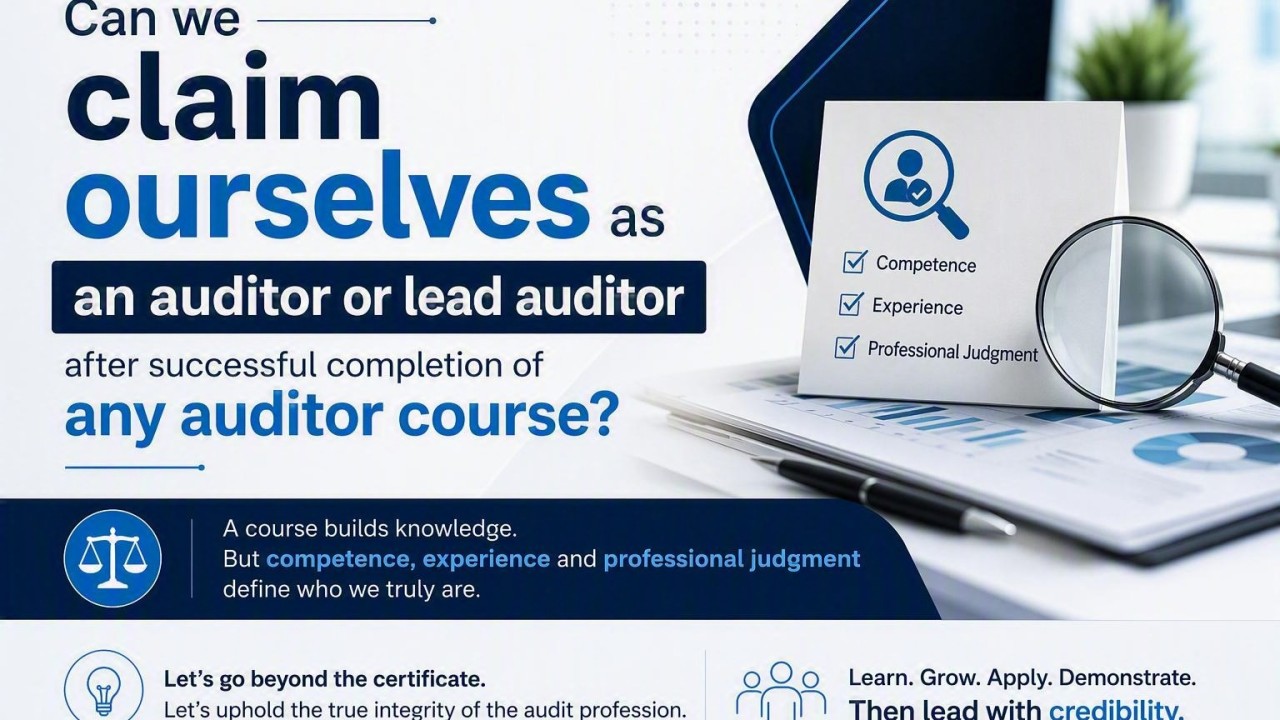
From Lead Auditor Training to Lead Auditor Recognition: Can We Claim to Be an Auditor or Lead Auditor After Successfully Completing an Auditor Course?
In today’s professional world, continuous learning has become a necessity rather than an option. Many professionals invest significant time and effort in attending various training programs to strengthen their knowledge and competencies. Among these, Auditor and Lead Auditor courses are particularly popular for management system and social compliance standards such as ISO 9001, ISO 14001, ISO 45001, SA8000, and many others.
While completing such training programs is undoubtedly a valuable achievement, there is a common misconception that deserves attention.
Many individuals complete an Auditor or Lead Auditor course successfully and then begin introducing themselves as “Lead Auditor”. Some even include the title on their business cards, email signatures, or professional profiles.
But does completing a successful Lead Auditor course automatically make someone a Lead Auditor?
The simple answer is:
No.
A Lead Auditor course provides the knowledge and foundational qualification necessary to begin a professional auditing journey. However, completing a training course alone does not automatically grant the professional status of Auditor or Lead Auditor.
To better understand this concept, let us consider a familiar example.
A person who completes an MBBS degree does not immediately become a licensed medical practitioner. Likewise, a person who graduates with an LLB degree cannot automatically practice law.
In both professions, obtaining academic qualifications is only the first step. Graduates must fulfill additional requirements, including professional examinations, supervised practice, registrations, licensing, and approvals before they are authorized to practice independently.
The auditing profession follows a very similar principle.
What Does a Lead Auditor Course Actually Provide?
A Lead Auditor course equips participants with knowledge of:
- Audit principles and methodologies
- Relevant management system standards
- Audit planning and execution techniques
- Reporting and communication requirements
- Professional responsibilities and ethical conduct
These competencies are essential, but they represent only the educational component of auditor qualification.
Professional auditing requires more than theoretical knowledge. It requires practical experience, sound judgment, audit skills, and demonstrated competence in real-world situations.
The Typical Journey to Becoming a Lead Auditor
Although the specific process may vary among audit firms, certification bodies, accreditation bodies, or certification schemes, the journey generally follows a structured path, and the person must work with an audit firm/ certification body or another authorized auditing organization.
1. Obtain Relevant Auditor Training
The first step is completing the applicable Auditor or Lead Auditor training course for the relevant standard.
This establishes the foundational knowledge required for auditing activities.
2. Gain Experience as a Trainee Auditor
After completing training, individuals are typically required to participate in audits as a Trainee Auditor.
This stage allows aspiring auditors to observe experienced professionals and develop practical auditing skills.
3. Demonstrate Competence Through Practical Audits
The trainee auditor participates in multiple audits under supervision and begins applying audit principles in real situations.
Competence is evaluated not only through technical knowledge but also through communication skills, reporting quality, interviewing techniques, objectivity, and professional judgment.
4. Undergo Witness Audits and Performance Evaluation
Once sufficient experience has been gained, the audit organization may assign experienced auditors to observe and evaluate the individual’s auditing performance through a witness audit.
The purpose of the witness audit is to assess whether the individual can effectively perform audit activities in accordance with professional requirements.
5. Achieve Approval as a Member Auditor
Following successful evaluation, the individual may be recommended for approval as a Member Auditor.
This approval is typically granted by the audit organization or the responsible certification authority, depending on applicable requirements.
6. Continue Building Audit Experience
Approval as a Member Auditor is another important milestone, but the journey does not end there.
The auditor continues participating in numerous audits, strengthening technical expertise, industry knowledge, and professional judgment.
7. Progress Toward Lead Auditor Status
Only after demonstrating consistent competence and accumulating sufficient audit experience may an auditor be considered for Lead Auditor responsibilities.
At this stage, additional witness audits and competency evaluations are often conducted to determine whether the individual possesses the leadership, decision-making ability, and technical competence required to lead an audit team.
8. Obtain Lead Auditor Approval
Following successful assessment and approval, the individual may finally be recognized and authorized as a Lead Auditor.
Only then can the person formally perform the role of Lead Auditor under the applicable organization’s requirements.
Additional Requirements for Certain Standards
Some certification schemes have separate requirements for Auditor and Lead Auditor qualifications.
For example, certain standards may require individuals to complete both basic auditor training and advanced or lead auditor training, along with additional practical experience and witness evaluations before Lead Auditor approval can be granted.
Therefore, completing a Lead Auditor course should be viewed as an important milestone rather than the final destination.
Why This Distinction Matters
Using professional titles accurately is more than a matter of terminology. It is a matter of professional integrity.
When we describe ourselves as Auditors or Lead Auditors without meeting the applicable competency and approval requirements, we may unintentionally misrepresent our qualifications.
As professionals, we should strive for transparency and accuracy in how we communicate our credentials.
There is a significant difference between saying:
“I am an ISO 9001 Lead Auditor.”
and
“I have completed successfully ISO 9001 Lead Auditor Training.”
The first statement implies professional qualification and recognition, while the second accurately describes the training completed.
Final Thoughts
Training is an essential part of professional development. Auditor and Lead Auditor courses provide valuable knowledge that enables individuals to understand standards, audit methodologies, and management systems.
However, training alone does not automatically create an Auditor or Lead Auditor.
Professional auditor status is built through practical experience, competency assessment, witness audits, continuous learning, and formal approval.
As members of the auditing profession, we should promote accuracy, credibility, and integrity by representing our qualifications responsibly.
Remember:
A certificate demonstrates learning. Experience demonstrates competence. Professional recognition is earned through proven capability.
Only when knowledge, experience, competence, and formal approval come together can someone truly claim the title of Auditor or Lead Auditor.
Author: Md. Asifur Rahman, Head of CR, Deltex Ltd. (Bangladesh Liaison Office)
ঢাকা বিভাগের আরো খবর



-

Pearl Global commissions new garment manufacturing unit in Bangladesh
-

The Truth Behind Audit Ratings: Why Strong Scores and Certifications Do Not Always Prevent Future Failures
-

From Lead Auditor Training to Lead Auditor Recognition: Can We Claim to Be an Auditor or Lead Auditor After Successfully Completing an Auditor Course?
-

Four more RMG factories earn LEED certification
-
শ্রমিক নিরাপত্তা দিবস উপলক্ষে ট্রপিক্যাল নিটেক্স লিমিটেডে বর্ণাঢ্য আয়োজন
-

The Silent Cost of Turnover in Bangladesh’s Garment Industry: Why Retention Matters More Than Recruitment
-

পোশাক শিল্পে স্থিতিশীল কর্মসংস্থান ব্যবস্থা: টেকসই উন্নয়নের অপরিহার্য ভিত্তি
-

শুল্কের দেয়াল ভাঙার সুযোগ: মার্কিন বাজারে বাংলাদেশের বড় পরীক্ষা
-

Honoring Excellence: Texstream Fashion Ltd. Rewards Best Workers–2026
-

Control Union Bangladesh Hosts Country’s First-Ever Carbon-Neutral Sustainability Conference
-

বিডিআরএমজিপি এফএনএফ ফাউন্ডেশনের ৫ম প্রতিষ্ঠাদিবস উদযাপন
-

Human Resource Management in Bangladesh’s Garment Industry: From Administrative Duties to Strategic Transformation
-

স্বাস্থ্য সচেতনতা বাড়াতে মাধবপুরে মহানগর পাবলিক স্কুলে আরকে নিট ডাইং মিলসের স্বাস্থ্যবিধি ও প্রাথমিক চিকিৎসা প্রশিক্ষণ
-

Fakir Fashion and Epyllion Represent Bangladesh at UN SDG Forum 2025 in Bangkok, Thailand
-

Texstream Fashion Ltd. Successfully Completes 2-Month Quality System Training Program






মতামত লিখুন :